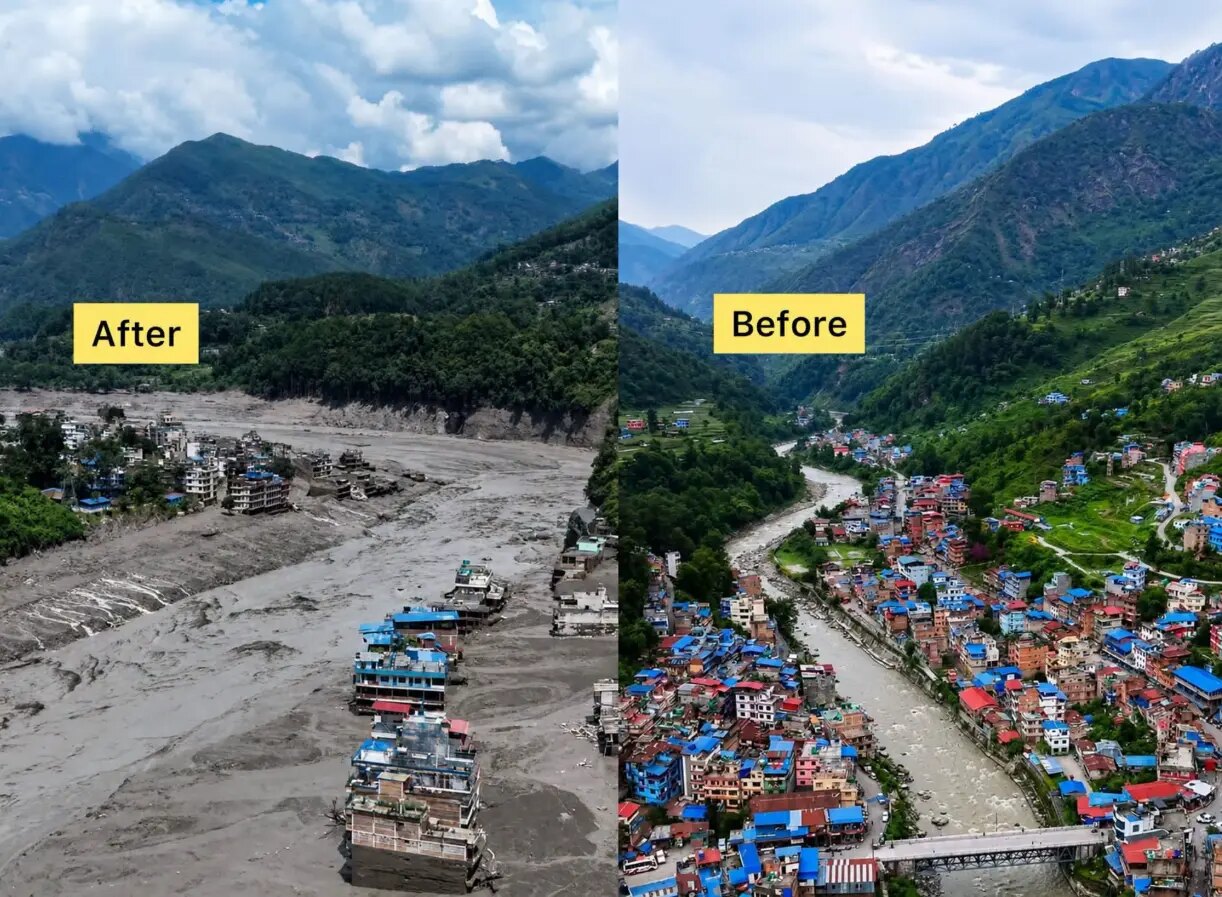
Nepal is being asked to pay an impossible price for a crisis it barely created. In 2023, Nepal accounted for approximately 0.107% of global territorial greenhouse-gas emissions. China accounted for about 30.1%, the United States 11.3%, and India 7.8%. Yet after the catastrophic Bhote Koshi flood of 26 August 2026, it is Nepalese families who are burying loved ones, searching for the missing and confronting a reconstruction bill estimated in the billions of dollars.
This is not charity. It is responsibility.
The case for major-emitter support is not based only on compassion. It rests on responsibility, capacity and shared risk. The countries that have produced the largest volumes of greenhouse gases possess far greater fiscal and technological capacity than Nepal. They should therefore lead in financing recovery, glacier monitoring, transboundary warning systems, safer infrastructure and long-term adaptation.
Emergency relief is necessary, but it cannot substitute for predictable, grant-based climate finance. Loans would require Nepal to assume new debt to repair damage linked to a global problem. That would make the victim pay twice: first through destruction, and again through repayment.
The victims were not only Nepalese
The Bhote Koshi disaster demonstrated how quickly a Himalayan catastrophe can become an international emergency. Foreign workers, pilgrims, travellers and families on both sides of the Nepal–China border were caught in the destruction.
These figures remain provisional because rescue, identification and family-notification work is continuing. That uncertainty is itself part of the disaster: governments across several continents are now trying to locate their citizens and support affected families.
India is downstream of Himalayan risk
For India, helping Nepal is both an act of solidarity and a matter of national interest. Himalayan rivers do not recognise political boundaries. Water, sediment and flood surges move from mountain catchments through Nepal into densely populated downstream areas.
The Narayani becomes the Gandak after entering India and ultimately joins the Ganges. Other Nepal–India river systems create similar interdependence. ICIMOD’s Glaciers-to-Ocean programme specifically connects cryosphere hazards in Nepal’s Koshi sub-basin with flood vulnerability in Bihar. A failure to monitor and manage upstream hazards can therefore expose Indian communities, infrastructure, agriculture and supply chains downstream.
India can help fund shared hydrological data, satellite monitoring, glacier and glacial-lake assessment, real-time alerts, resilient bridges and coordinated evacuation protocols. The investment protects people in Nepal and India simultaneously.
China also shares the mountain system
China and Nepal share a fragile high-altitude frontier. The 2026 disaster damaged communities and facilities on both sides. Chinese workers were among those caught in Nepal, while families in Tibet also suffered deaths and disappearances. This is a direct reminder that Himalayan climate adaptation cannot be organised one country at a time.
China has advanced satellite, engineering and disaster-response capacity. Sharing data, financing resilient reconstruction and cooperating on cross-border warning systems would save lives while protecting Chinese citizens, investments and regional trade routes.
Why the United States should act before displacement grows
The United States may be geographically distant, but it is not insulated from climate-related instability. Climate hazards can destroy homes, livelihoods, food security and local economies. Most people displaced by disasters remain inside their own countries or nearby, but prolonged loss and repeated shocks can also contribute to wider migration pressures when safe recovery becomes impossible.
The World Bank has warned that, without decisive climate and development action, climate impacts could drive as many as 216 million people to move within their own countries by 2050 across six world regions. UNHCR likewise recognises that climate change interacts with displacement and protection risks.
It would be simplistic to claim that every displaced Nepalese person will travel to the US border. But it is equally unrealistic to pretend that repeated global disasters have no consequences for international migration systems. The United States already spends substantial public resources on border processing, immigration detention and removals. Earlier investment in resilience and safe recovery is more humane and strategically wiser than waiting until families have lost every viable option at home.
The world has seen this pattern before
Climate risk is already crossing borders in many forms: wildfire smoke travels between Canada and the United States; drought and crop failure destabilise food markets; floods interrupt global manufacturing and shipping; rising seas threaten coastal cities and island states; and heat waves strain power grids and public-health systems across continents.
The lesson is not that every disaster has one simple cause. It is that a warmer world intensifies hazards and compounds existing vulnerabilities. Countries cannot protect themselves through borders alone when they share an atmosphere, river basins, markets, migration routes and humanitarian obligations.
What major emitters should do now
- Provide grant-based recovery finance proportionate to verified loss and damage, without adding to Nepal’s debt.
- Capitalise the Fund for Responding to Loss and Damage at a scale capable of responding to catastrophes measured in billions.
- Create a Nepal–Himalayan resilience compact covering glaciers, river basins, hydropower, settlements and transboundary early warning.
- Share technology and data for satellite monitoring, hazard mapping, forecasting and rapid alerts.
- Cut emissions faster, because adaptation cannot indefinitely protect mountain communities from unchecked warming.
One million signatures can strengthen Nepal’s voice
Prime Minister Balendra Shah told Nepal’s House of Representatives that the country must forcefully present its climate losses to the international community. He is scheduled to address the 81st United Nations General Assembly on 24 September 2026.
A million verified signatures will not replace diplomacy, science or finance. But they can demonstrate a clear global mandate: Nepal is not asking for pity. Nepal is demanding accountability, compensation and protection before the next disaster.
Stand behind Nepal at the United Nations.
Add your name, then ask three more people to do the same.
Sign the climate justice appeal